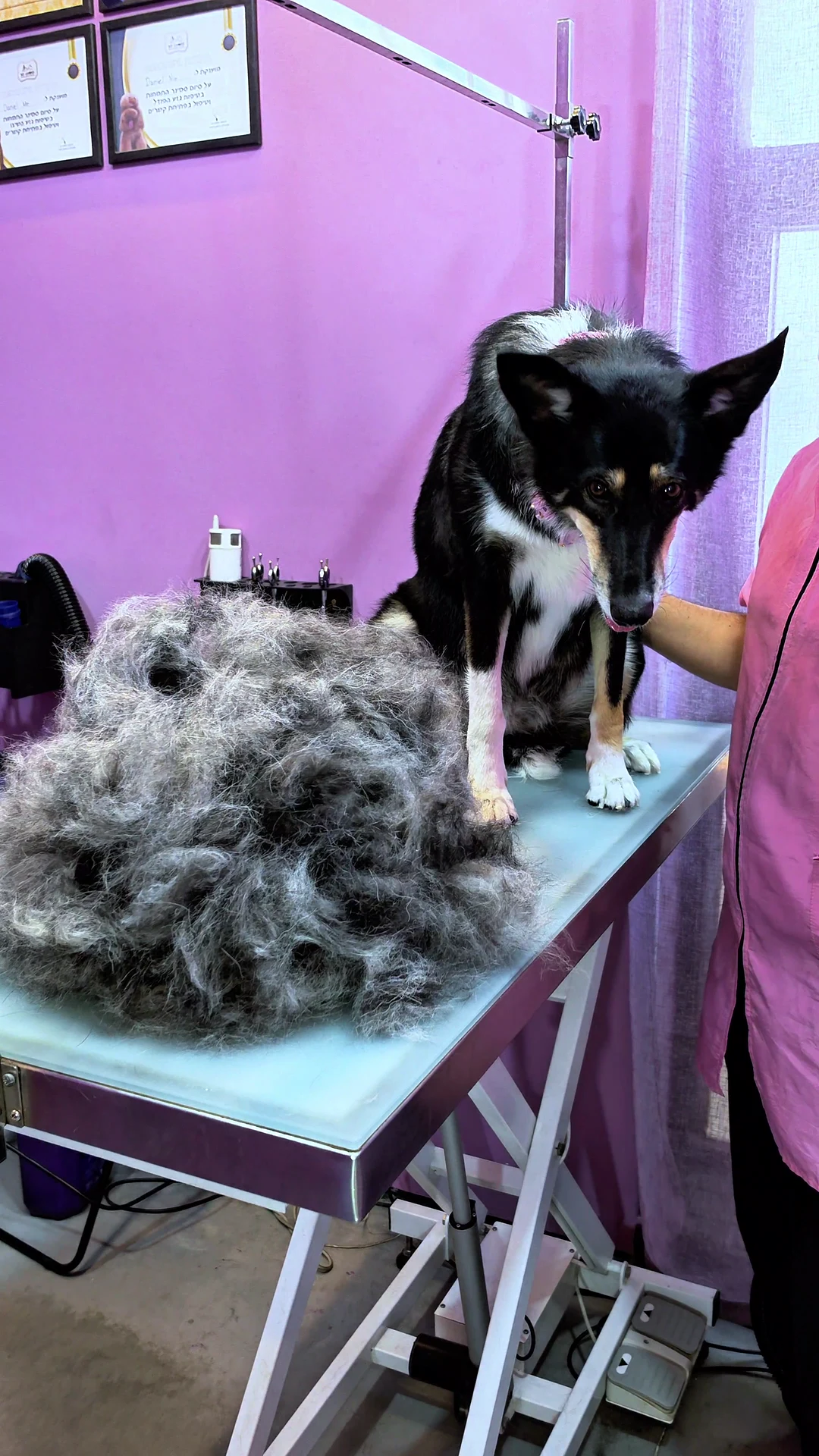
Rey, beside all the coat removed from her in a single Asian de-shedding.
Our own AsianDe-shedding.
A deep de-shedding that clears the coat of everything it no longer needs, keeps all that is alive and healthy in it, and brings new life to the skin and coat, to the dog, and to the whole home.
About one to two hours for a small dogFrom ₪380Without shaving
We reply to every new inquiry within three business days at most.
True de-shedding goes on even after the dog is dry,and ends only when the coat stops coming out in clumps.
In suitable cases, a full Asian de-shedding can mean about 90% less loose coat reaching your home in the period that follows. The skin breathes again, the coat stays healthy, soft, and shiny, and the home is cleaner. The exact amount depends on the type of coat, the stage of shedding, the dog’s health, and maintenance, so the number is not something we promise in advance. The work always is. And unless there is an unusual medical condition, we can always show you how to reach a result like this.
How a full Asian de-shedding is done.
Six stages, ending with a test there’s no getting around: we run a hand over the coat and see how much hair it picks up.
Before the treatment, every touch brings out clumps of coat.
Run your mouse over the coatRun a finger sideways across the coat
01 / 06
01
Assessment and tailoring
We begin with the skin and coat: we check the type of coat, the density of the undercoat, any compacted coat or mats, and the time since the last treatment. Based on what we find, we tailor the products and the order of the work, and we photograph the starting point.
02
Preparing for the bath
Before the coat gets wet, we brush it, and when needed we loosen compacted coat or mats with a product made for the purpose. A short coat usually does not need this.
03
A bath in three stages
In every full de-shedding, the bath includes two shampoo stages and a mask. The products stay on the coat for a set time, long enough to work and to soak in, and the temperature changes at each stage according to what that stage is meant to achieve.
04
Deep drying
We dry with a powerful twin-motor high-velocity dryer, brushing all the while. This is when most of the dead coat comes out: both what is ready to shed and what has already shed and been trapped in the coat.
05
Work by hand
After drying comes a long stretch of hand work, with tools that change according to the structure of the coat, such as an undercoat rake, a Coat King, and a stripping stone. When needed, we tidy the outline with scissors and tend to the paws, the sanitary areas, the nails, and the ears.
06
The hand test
After a full Asian de-shedding, a simple stroke of the hand along the coat should pick up no more than a few loose hairs. If it picks up more, the work isn’t done yet. Once the hand comes away almost clean, we move on to the finish and the fragrance you chose, and then we tell you what we did and what’s worth doing at home.
We keep the full sequence, the formulas, and the inner workings of the method to ourselves.
Who Asian De-shedding is for
De-shedding suits dogs who shed, short-haired dogs, and double-coated dogs, small and large alike, and mixed breeds too. We decide whether it is right for your dog by the coat itself; the name of the breed is only part of the picture.
Small and short-haired
Pug
French bulldog
Chihuahua
Beagle
Small and medium, with a dense or double coat
Pomeranian
Spitz
Shiba Inu
Corgi
Pomsky
Medium and large
Labrador
Golden retriever
Husky
Samoyed
German shepherd
Australian shepherd
Border collie
Malamute
Caucasian shepherd
Deep brushing draws out the dead coat until it comes away in clumps.
A twin-motor dryer opens up the coat down to the skin and blows out what is ready to shed.
Even a short coat can fill a whole house.
With a pug, a French bulldog, a Chihuahua, or a beagle, we work with a different technique and different tools from those that suit a Pomeranian, a husky, or a golden retriever. There is usually no need for brushing or working out mats before the bath, and a treatment for a small dog takes about one to two hours, including trimming and filing the nails.
In mixed, short, or wire coats, we may add Carding or spot stripping of dead hair. When the coat needs full Hand Stripping, that is a separate service. True hand stripping is a rare craft, and most grooming salons do not do it.
On a double coat, shaving is a shortcut,and for shortcuts we have no patience.
A double coat is part of a dog’s natural protection, so we are in no hurry to shave it. Shaving is not a shortcut to de-shedding. When we are asked to shave, we first explain what a full de-shedding can do instead, and we shave only when there is a real reason for it: a vet’s instruction, surgery or medical treatment, mats or compacted coat that cannot be worked out safely, an extreme situation with no alternative, or a coat that has already changed because of earlier damage, when the owner asks for it.
A story from the salon
The Labrador who looked like a puppy again.
The story of a four-and-a-half-year-old Labrador whose owners came to us with a single request: to shave him.
Four and a half hours later, the dog standing before us looked like a one-year-old puppy again, with his coat still on him.
The beginningFor at least a year he had not had a real de-shedding. Every stroke brought out clumps of coat, and at home the shedding never stopped for a moment.
The requestNothing his owners had tried until then had helped, and shaving seemed to them the simplest and easiest solution.
The wayWe told them the truth about shaving a double coat, and offered another way. They chose to try it. Four and a half hours of de-shedding, at his pace and without a single shortcut, until all of the dead coat had come away and the living coat remained in place.
TodayHis owners told us they had never seen a result like it. Since then they have come back to us regularly, every two and a half months, and at home they bathe him with the shampoo they bought at the salon.
An exceptional case
A Caucasian shepherd who had gone more than two years without grooming needed two days of work, about six hours each day, including working out mats and a full de-shedding. Finishing in one day would have been possible only with a shortcut, so we divided the work according to what he and his coat could bear.
A full de-shedding, then maintenance.
Here, every path begins with a full de-shedding. The maintenance plan comes only after it, and is meant mainly for large dogs and for dogs who shed almost all year round.
Full De-shedding
Full De-shedding
A deep seasonal treatment, and the path we recommend for small and medium dogs.
Month 1Month 6
Your dog comes in every two and a half to three months, in the middle or at the end of a change of season. After a full de-shedding the coat repels dust and dirt, so there is no need to bathe your dog every month, and at home it is enough to brush them at least once a week.
from ₪380for a small dog
De-shedding Maintenance
De-shedding Maintenance
For large dogs, for dogs who shed almost all year round, and for anyone who wants their dog to be well groomed at all times.
Month 1Month 6
After the full de-shedding, your dog comes in every one to one and a half months for a treatment built on the same principles and the same stages, in about half the time. This way shedding stays light all year round, your dog stays cleaner, and grooming becomes a familiar routine for them.
₪330per hour of work
Full de-shedding at the salonMaintenance visit at the salonBrushing at home
Every plan begins with a full de-shedding, because a short treatment on a coat that is still weighed down changes almost nothing, and it would be a waste of your money. Small and medium dogs continue with full de-shedding afterward as well. In certain medical or health situations, we will recommend only maintenance or a partial de-shedding, after a professional assessment.
Full De-shedding by size and coat
Small dogAbout one to two hours
₪380
Medium dogAbout two to four hours
₪420–660
Large dogFrom three hours, sometimes six to ten
₪330 per hour
Giant dog, or an especially deep coat
₪330 per hour
Short, dense coat
₪330 per hour
De-shedding Maintenance
Visit on the maintenance plan
₪330 per hour
Regular clients can buy a series of treatments in advance, at a preferred rate.
The price includes
A check of the skin and coat, and products matched to them
A bath in three stages
Deep drying with a twin-motor dryer, brushing as we go
Hand work with specialized tools
Ear cleaning
Nails, trimmed and filed for small dogs, and as needed for large ones
Finishing, with a light fragrance or no scent at all
An explanation, guidance for home care, and follow-up
What affects the price
Weight and size
Coat type
Undercoat density
Time since the last treatment
Compacted coat and mats
Behavior
Age and physical condition
Parasites
Drying time
Tidying the outline with scissors
Possible extras
Parasite treatment, including cleaning and disinfecting the room
₪130
Second bath after an accident
₪100
Late pickup, over 30 minutes
₪60
Late pickup, over an hour
₪150
The prices here are a starting point, and the final price depends on the dog. Nothing is added without your knowledge: if something comes up that goes beyond the treatment we planned, we will let you know and explain why, whenever possible before we continue.
Before, after, and in between.
The result of a full de-shedding lasts when the routine at home suits the coat as well.
Before you come
A short walk beforehand, so your dog can relieve themselves.
No meal for about two hours before the treatment, unless you have been given other medical instructions.
Information in advance about your dog’s health, medication, and sensitivities.
A few words about how your dog has responded to previous treatments.
Recent photos, attached to your request to join.
No bath at home in the days before the treatment.
A leash and collar, or a harness, in good condition.
At home, by coat type
Short coat
A silicone brush or a rubber glove, once a week.
Medium-length double coat
A Coat King matched precisely to the breed, the length, and the density.
Long or arctic coat
A suitable Coat King, and when needed, a long-pin brush for working out mats as well.
It is worth choosing a tool by the coat; the name on the tool is not enough to go by. The wrong tool, or working too vigorously, can pull out healthy coat as well, so we will gladly show you how to use it before you begin.
When shedding is unusual
Bald patches, odor, dandruff, itching, sores, redness, or a sudden change are signs that the issue goes beyond grooming. In such cases we will recommend looking at your dog’s diet, health, and lifestyle as well. Our guidance is general, and when needed we will refer you to a vet, a nutritionist, or another suitable professional.
Client reviews
The reviews here are written by clients through the form on this page, and signed with the client’s name and the name of their pet. Every review is verified by email, and appears on the site only after we have read and approved it.
Common questions
And if you still have a question, we’d be glad to hear it on WhatsApp.
Does de-shedding stop shedding completely?
No. A healthy dog keeps renewing their coat, and that is entirely natural. A full de-shedding removes the dead coat, both what is ready to shed and what has already shed and been trapped in the coat, so in the period after the treatment far less coat reaches your home. When there is a medical problem or a diet that does not suit the dog, shedding may continue, in much smaller amounts, and then we will usually recommend the maintenance plan.
Can you just shave my dog?
It is possible, but it is a shortcut. Shaving shortens the hair and leaves the dead undercoat where it is. It does nothing to reduce shedding, either, and in most cases it makes it much worse. So before anything else we explain what a full de-shedding can do, and we shave only when there is a real reason for it, such as a vet’s instruction, surgery, or mats that cannot be worked out safely.
Is de-shedding right for a short-haired dog too?
Yes, and sometimes that is exactly where the big surprise waits. Pugs, French bulldogs, Chihuahuas, and beagles can leave a lot of coat around the house. With a short coat we work with a different technique and different tools, usually without brushing or working out mats before the bath, and a treatment for a small dog takes about one to two hours.
Why can the treatment take four or six hours?
Because we remove all the dead coat, including what does not let go easily, and we finish only when the coat no longer comes out in clumps. The clock is set by the dog and their coat: the size, the type and density of the coat, the time since the last de-shedding, any mats, and the dog’s own pace. A small dog needs about one to two hours, a medium dog about two to four, and a large dog at least three hours, sometimes six to ten. In exceptional cases, we spread the work over more than one day.
How often should we come back?
With full de-shedding, dogs usually come back every two and a half to three months, in the middle or at the end of a change of season. On the maintenance plan, they come every one to one and a half months. Between visits, we recommend brushing at home at least once a week.
Does the treatment hurt?
Proper de-shedding should not hurt. We remove coat that is already dead and ready to come out, with tools suited to the type of coat and at the dog’s pace. Pain when touched, sores, or redness are a reason to stop, postpone, or change the treatment.
How do de-shedding, stripping, and cutting differ?
De-shedding removes the dead coat from the undercoat and keeps the healthy coat and its length. Hand Stripping removes the dead hair by hand from the wire coats of certain breeds, so that a new, resilient coat can grow in its place. It is a rare craft, and at our salon it is a separate service. Cutting shortens and shapes the coat, with scissors or clippers.
What if there are sores or redness?
We check the skin before we begin. Sores, significant redness, pain when touched, bald patches, parasites, an active medical problem, pregnancy, or certain medications can mean postponing the treatment or changing it. In such cases we will first recommend a veterinary checkup, or a more limited treatment.
Can you do just part of the treatment?
Usually not. We always begin with a full de-shedding, because a short treatment on a coat that is still weighed down changes almost nothing. After that, for large dogs and for dogs who shed almost all year round, there is a maintenance plan built on the same principles and the same stages, in about half the time. In certain medical or health situations, we will recommend only maintenance or a partial de-shedding from the start.
What should I do at home afterward?
Brush your dog at least once a week, with a tool that suits the coat: a silicone brush or a rubber glove for a short coat; for a double coat, a Coat King matched to the breed, the length, and the density; and for a long or arctic coat, a long-pin brush as well. After a full de-shedding the coat repels dust and dirt, so there is no need to bathe your dog every month.
How do I know if my dog needs full de-shedding or maintenance?
We always begin with a full de-shedding, and after that we decide according to the size of the dog, the coat, and the routine at home. Small and medium dogs continue with full de-shedding. The maintenance plan is mainly for large dogs, for dogs who shed almost all year round, and for anyone who wants their dog well groomed at all times. In certain medical or health situations, we will recommend only maintenance or a partial de-shedding.
We do not start with a tool. We start with the coat.
Show us your starting point, just as it looks on the couch today, and we will build the treatment from there. Recent photos and a few details about your dog are enough to begin, and we will reply within three business days at most.