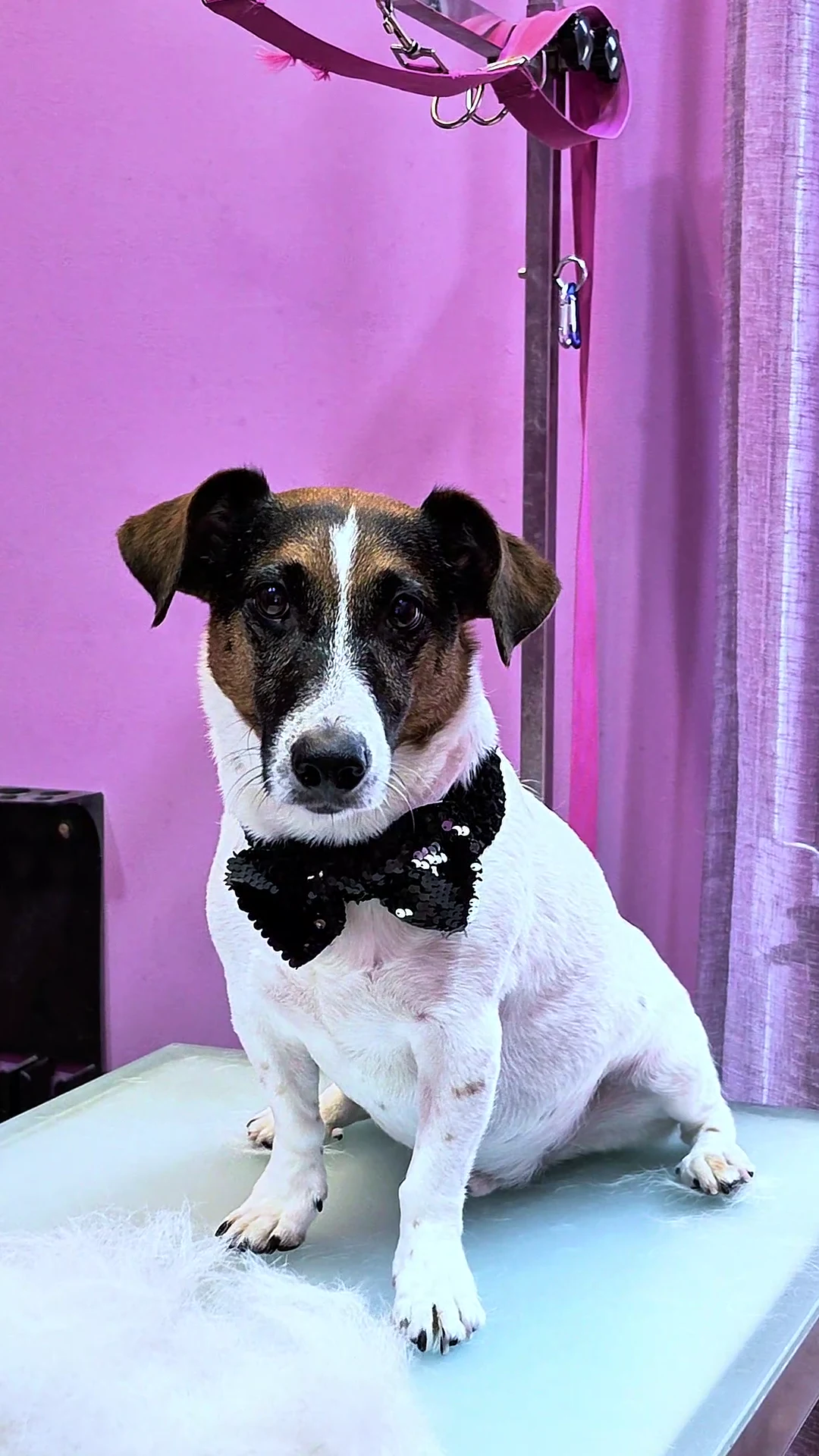
Bob, a Jack Russell Terrier, at our salon after stripping with the knife and the brush.
Hand Stripping,hair by hair.
With patient handwork we draw out the dead hair from the root, and make room for the coat the breed was born with: new, healthy, resistant to dirt and water, in its natural texture and color.
We reply to every new inquiry within three business days at most.
Most owners don’t knowjust how beautifultheir dog can be.
A wire-coated dog who has been shaved for years slowly loses the very things that make their coat what it is: the harsh tip, the deep color, and the resistance to dirt and water. Patient stripping gives all of it back. We draw out the dead hair by hand, from the root, and a new hair grows in its place, the way the coat was meant to be all along. It takes time, and every moment along the way is worth it.
Three ways to strip a coat.
Each has its own rhythm and its own outcome. We choose the direction together, based on what you want for your dog and on the result we are aiming for, and the pace, as always, is the dog’s to decide.
Before the treatment, the dead hair is loose and scattered.
Run your mouse over the coatRun a finger sideways across the coat
Full Strip
Full Hand Strip
All the dead hair comes out in a single visit, and the new coat grows in even and complete. For the first few weeks the dog looks very close-cropped, and usually, some ten to twelve weeks later, the coat is back at its best. This is the way we chose for the Cairn whose story you will find further on.
Rolling Coat
Rolling Coat
When a coat is made of several layers of different lengths, at each visit we remove only the longest layer, which has already died. A shorter coat always remains beneath it, so the dog never looks close-cropped. This is the most common way for family dogs, with a visit once a month.
Staging
Staging
When a dog needs to look their best on a particular day, such as a show day, we strip each area of the body at a different time. Every area grows at its own pace and needs its own length, so the plan is built backward from the chosen date.
Clipping
Shaving with clippers
Clippers cut through the harsh hair that carries the color, and leave mostly the soft layer beneath it. After every shave the coat grows softer and paler, and more prone to tangling. That is why, for a dog whose coat is meant to be stripped, the clippers wait at the very end of the line.
Alongside these three ways there is also partial stripping and Carding, in which we strip only certain areas, or use specialized tools to remove the soft layer beneath the harsh hair. In the sensitive areas we adapt the work to the dog, and sometimes bring in scissors as well.
Real hand stripping is a rare craft, and most grooming salons don’t do it.
It can sound close to de-shedding, and in some respects the result is similar too: less shedding at home and a cleaner coat. Yet it is a different discipline, suited only to certain breeds, and it calls for wider knowledge and experience.
This is real hand stripping.
Bob, a Jack Russell Terrier, on the grooming table at our salon: first the knife, then the brush, and finally the pile of coat that came off him.
The knife
We strip with a professional stripping knife made for the purpose, which gently draws out the dead hair, hair by hair.
The brush
Then, even before the bath, a special silicone brush goes over the coat, encouraging the dead hair to come loose.
The pile
All of this coat came from a single smooth, short-coated dog. It shows how much dead hair hides even in a coat that looks short.
Who stripping is for
Stripping suits breeds with a harsh wire coat, small and large alike, and mixed breeds as well. In a mixed breed the wire coat sometimes shows itself only when we examine the dog, or even only once the treatment is under way.
Wire-coated terriers
Cairn
West Highland
Border
Scottish
Wire Fox
Norfolk
Norwich
Jack Russell
Airedale
Schnauzers
Miniature
Standard
Giant
Other wire coats
Wire-haired dachshund
Brussels Griffon
Cocker spaniel
Large breeds, case by case
German Wirehair
Pointing Griffon
Irish Wolfhound
After the knife comes a silicone brush, and his head rests quietly in the palm of a hand.
Even a coat shaved all its lifecan be itself again.
Coat Recovery after shaving begins by drawing out the dead hair and the soft layer, to make room for the harsh hair to grow back. It is a path of one to two years, sometimes three, and at the start, visits are scheduled once every month and a half to two months. The road is long and has no shortcuts, and waiting at the end of it is your dog as they truly are. The Cairn you will meet further on had also been shaved all his life, and after a Full Hand Strip he grew a new coat.
In a short or mixed coat, stripping the dead hair from certain areas is sometimes enough, and sometimes a Full Hand Strip is needed. And when the coat is a double coat that sheds, the right way is usually de-shedding.
The story of a three-year-old Cairn Terrier whose coat had been shaved all his life.
His owner saw his dog as he had never imagined him.
The beginningWhen he came to us, his owner had only ever known him shaved, and had never imagined that a completely different coat was waiting underneath.
The conversationWe explained to him that once the dead hair is drawn out, a new, healthy coat can grow in its place, resistant to dirt and water, as it was meant to be from the start, before it was ever shaved.
The wayHis owner agreed to try, and the dog had a Full Hand Strip with us. All the dead hair came away, to the very last strand, and over the weeks that followed a new coat grew in its place.
TodaySince then they have come back to us once every three months. The house is free of shed hair, his coat is lovelier than ever, to the touch and to the eye, and he finally looks like a Cairn.
Two plans,to suit your dog and their coat.
We will choose the plan together, after a close look at the coat.
Full Hand Strip
Full Hand Strip
A new, even coat that comes in after a few weeks in which your dog looks close-cropped.
Month 1Month 6
All the dead hair comes out in a single visit, and the coat grows back even and complete. The Cairn from the story comes back to us once every three months.
₪420for a small dog
₪660for a medium dog
₪330per hour, for a large dog
Rolling Coat
Rolling Coat
Your dog looks neat at all times, and the visits keep a steady rhythm.
At each visit only the longest layer comes out, the one that has already died, and a shorter coat is waiting beneath it. Visits are scheduled once a month, and each one lasts as long as the outer coat needs.
₪330per hour of work
A Full Hand Strip gives a new, even coat, but for the first few weeks the dog looks very close-cropped. With Rolling Coat the dog looks neat at all times, and the coat renews itself gradually, visit after visit.
Full Hand Strip about once every three months
Small dogAbout an hour and a half
₪420
Medium dogTwo to three hours
₪660
Large dogThree and a half to six hours
₪330 per hour
Other kinds of stripping
Rolling CoatOnce a month, for as long as the outer coat needs
₪330 per hour
StagingPlanned backward from the chosen date
₪330 per hour
Pet StripA combination of techniques as needed, once every two to two and a half months
₪330 per hour
Partial stripping and CardingFor certain areas, or for a coat not yet ready all over, usually once every month and a half
₪330 per hour
Coat Recovery after shaving or scissoringA process of one to two years, sometimes three, starting with a visit once every month and a half to two months
₪330 per hour
Combination GroomStripping, Carding, de-shedding, and scissoring, as the coat needs, over two to six hours
₪330 per hour
Regular clients can buy a series of treatments in advance, at a preferred rate.
The price includes
An assessment of the skin and coat, and the choice of the right way
Professional products, chosen especially for your dog
Bathing in several stages
Full, controlled drying
Nails and ears, as needed
Finishing, with a light fragrance or no scent at all
Summary and guidance for home care
Follow-up after the treatment, when needed
What affects the time and the price
Size and weight
Coat type and condition
Time since the last treatment
Compacted coat and mats
Behavior
Age and physical condition
Possible extras
Parasite treatment, including cleaning and disinfecting the room
₪130
Second bath after an accident
₪100
Late pickup, over 30 minutes
₪60
Late pickup, over an hour
₪150
The prices here are a starting point, and the final price depends on the dog. Nothing is added without your knowledge: if something comes up that goes beyond the treatment we planned, we will let you know and explain why, whenever possible before we continue.
Before, after, and in between.
A properly stripped coat stays clean longer, and sheds very little at home.
Before you come
A short walk beforehand, so your dog can relieve themselves.
No meal for about two hours before the treatment, unless you have been given other medical instructions.
Information in advance about your dog’s health, medication, and sensitivities.
A few words about how your dog has reacted to past treatments, and whether they have been shaved before.
Recent photos, attached to your request to join.
No bath at home in the days before the treatment.
A leash and collar, or a harness, in good condition.
Between visits
At the end of every visit we give you a summary of the work and home-care guidance suited to your dog’s coat. That way the new coat stays resilient and beautiful until the next visit.
When something is not right
Sores, redness, pain when touched, bald patches, or parasites are reasons to stop the treatment, postpone it, or change it. In such cases we will first recommend a veterinary checkup.
Client reviews
The reviews here are written by clients through the form on this page, and signed with the client’s name and the name of their pet. Every review is verified by email, and appears on the site only after we have read and approved it.
Common questions
And if you still have a question, we’d be glad to hear it on WhatsApp.
How do stripping and shaving differ?
Clippers cut through the harsh hair that carries the color, and leave mostly the soft layer beneath it, so after every shave the coat grows softer and paler. In stripping, we draw out the dead hair from the root, and a new hair grows in its place, true to the breed in texture and color.
Does stripping hurt the dog?
Stripping done properly should not hurt, because we remove only hair that is already dead and comes away easily. Your dog decides the pace and the breaks, and in the sensitive areas we adapt the work to the dog. Pain when touched, sores, and redness are all reasons to stop the treatment, postpone it, or change it.
Can a dog shaved for years grow a wire coat again?
Usually yes, although it takes time, and sometimes several visits. The Cairn from the story had been shaved all his life, and after a Full Hand Strip he grew a new coat, healthy and resistant to dirt and water.
How do a Full Hand Strip and Rolling Coat differ?
In a Full Hand Strip, all the dead hair comes out in a single visit and the new coat grows in evenly, though for the first few weeks the dog looks very close-cropped. With Rolling Coat, only the longest layer comes out at each visit, and the dog looks neat at all times. We will choose the way together, based on what you want for your dog and on the result we are aiming for.
How often should we come back?
It depends on the way we choose and on the coat. With a Full Hand Strip, you come back about once every three months, like the Cairn from the story. With Rolling Coat, once a month; with a Pet Strip, once every two to two and a half months; and with partial stripping, usually once every month and a half. In Coat Recovery after shaving, visits at the start are scheduled once every month and a half to two months.
Which dogs is stripping right for?
For breeds with a harsh wire coat, such as the Cairn, West Highland, Border, schnauzer, wire-haired dachshund, and Brussels Griffon, and for large breeds too, case by case. In mixed breeds this becomes clear on examination, and sometimes only during the treatment. For some dogs, stripping the dead hair from certain areas is enough; others need a Full Hand Strip.
How do stripping and de-shedding differ?
De-shedding draws the dead coat out of the undercoat, in double coats that shed. Stripping removes the harsh hair once it has died, in the wire coats of certain breeds, so that a new hair can grow in its place. In some respects the result is similar, yet it is a different discipline, one that calls for wider knowledge and experience.
Why does stripping take longer than a haircut?
Because we remove the dead hair by hand, from the root, hair by hair. A clipper would finish sooner, and hand you back a different dog. Here the pace is set by the dog, and the result is worth the time.
Should I bathe my dog before we come?
There is no need. It is better not to bathe your dog at home in the days before the visit; we will give the bath ourselves, as part of the treatment.
What is Carding?
Carding removes the soft layer beneath the harsh hair, using specialized tools. Sometimes it is done on its own, and sometimes together with stripping.
Your dog’s real coat is waiting underneath.
Send us recent photos and a few details about your dog, and tell us whether they have been shaved before. It happens to the most loving owners, too, and that is exactly where we begin. We will get back to you within three business days at most.